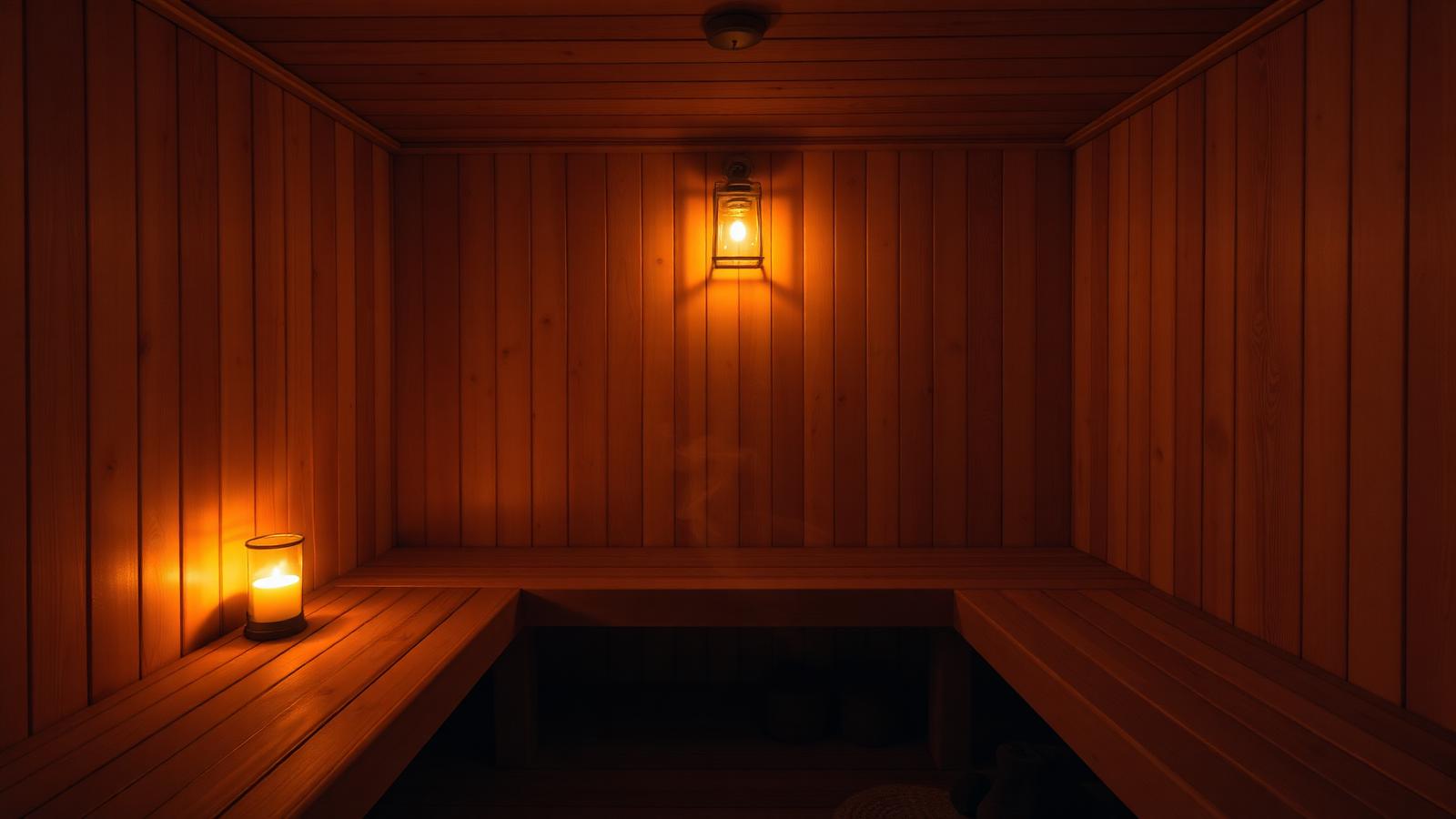
Wellness Research
The Quiet Science of the Sauna
What decades of research — including a long-running study from Japan — reveal about heat, the heart, and the nervous system.
May 2026 · 9 min read
For most of the modern era, the sauna was treated as a cultural ritual rather than a clinical intervention. That has changed. Over the past three decades, two parallel research programs — one in Finland, one in Japan — have followed thousands of regular bathers and patients, and the picture that has emerged is unusually consistent: deliberate, repeated exposure to dry heat appears to recalibrate the cardiovascular and autonomic systems in ways that are measurable, durable, and broadly protective.
The Japanese program: thirty years of "Waon therapy"
In 1989, cardiologist Chuwa Tei and colleagues at Kagoshima University began experimenting with a milder, medically supervised form of dry sauna for patients with severe chronic heart failure — people who, by definition, tolerate exertion poorly. They built a far-infrared room held at a steady 60 °C, sat patients in it for fifteen minutes, then wrapped them in blankets for thirty minutes of post-warming. They called the protocol Waon therapy: wa for soothing, on for warmth.
What began as a small clinical experiment turned into a research program that has now run for more than three decades. Across that period, Tei's group and collaborators have published dozens of trials examining the same intervention in heart failure, peripheral arterial disease, fibromyalgia, and chronic fatigue syndrome. The headline finding came in 2008, when a prospective study of 129 chronic heart-failure patients reported that those who received Waon therapy in addition to standard care had significantly fewer cardiac events and lower all-cause mortality over five years of follow-up.1 A multicentre randomised trial, WAON-CHF, published in 2016 confirmed improvements in heart-failure symptoms and B-type natriuretic peptide.2
The proposed mechanism is elegant. Mild, sustained heat dilates peripheral vessels, reduces cardiac afterload, and — repeated over weeks — appears to improve endothelial function: the thin lining of blood vessels that governs how readily they relax. In effect, the sauna trains the vasculature in much the way that aerobic exercise does, but without mechanical load.
The Finnish cohort: 2,315 men, twenty years
If the Japanese work is clinical, the Finnish work is epidemiological. The Kuopio Ischaemic Heart Disease Risk Factor Study has tracked a population-based cohort of middle-aged men since the 1980s. In 2015, Tanjaniina Laukkanen and colleagues published the first analysis of sauna habits within that cohort: 2,315 men, followed for a median of 20.7 years.3
Compared with men who used a sauna once a week, men who used a sauna 4–7 times a week had a 63% lower risk of sudden cardiac death and a 40% lower risk of all-cause mortality.
The dose-response was clean: more frequent sessions and longer sessions (over 19 minutes) tracked with progressively lower risk, and the relationship survived adjustment for the obvious confounders — age, smoking, blood pressure, cholesterol, physical activity, socioeconomic status. A follow-up paper from the same group in 2018 extended the finding to a 50% reduction in dementia and Alzheimer's risk in the highest-frequency group.4
What the body actually does in the heat
A single 20–30 minute session at 80–100 °C produces a physiological response that mirrors moderate-intensity exercise: heart rate climbs to 120–150 bpm, cardiac output roughly doubles, and skin blood flow can increase up to seven-fold.5 Plasma norepinephrine rises sharply; growth hormone and prolactin follow. After the session, blood pressure typically falls below baseline and arterial stiffness decreases — effects that persist for hours.
Repeated over weeks, this acute response appears to consolidate. Trials measuring flow-mediated dilation, pulse-wave velocity, and ambulatory blood pressure consistently show improvements in vascular compliance among regular bathers, particularly those starting from a hypertensive or sedentary baseline.6
| Outcome | 1× / week | 2–3× / week | 4–7× / week |
|---|---|---|---|
| Sudden cardiac death | reference | −22% | −63% |
| Fatal CHD | reference | −23% | −48% |
| All-cause mortality | reference | −24% | −40% |
| Dementia | reference | −22% | −66% |
| Alzheimer's disease | reference | −20% | −65% |
| Hypertension (incident) | reference | −24% | −46% |
| Pneumonia | reference | — | −41% |
Beyond the heart
- Stress and sleep. Heat exposure activates the parasympathetic nervous system in the recovery window, and self-reported sleep quality improves in most observational studies of regular users.
- Inflammation. Markers including C-reactive protein, IL-6, and fibrinogen trend downward in cohort data, consistent with a mild, repeated heat-shock-protein response.
- Respiratory health. The Kuopio cohort also found a roughly 40% lower incidence of pneumonia among frequent users — an unexpected but reproducible signal.7
How to read the evidence
The honest caveats: the largest cohort is observational and predominantly male, and people who sauna frequently may differ from those who do not in ways no statistical model fully captures. Yet the convergence of a thirty-year Japanese clinical program, a twenty-year Finnish prospective cohort, and a growing body of mechanistic work is unusual. Few non-pharmacological interventions in cardiovascular medicine carry this depth of evidence.
The practical reading is modest. Two to four sessions a week, 15–25 minutes per session, hydrated, with a cool plunge or shower between rounds — that is the dose at which the literature converges. It is not a substitute for sleep, movement, or diet. It is, on the available evidence, a meaningful adjunct to all three.
Sources
- 1.Kihara T, Miyata M, Fukudome T, et al. "Waon therapy improves the prognosis of patients with chronic heart failure." Journal of Cardiology, 53(2):214–218 (2009). Link
- 2.Kihara T, Tei C, et al. "Waon Therapy for Managing Chronic Heart Failure — Results From the Multicenter Prospective Randomized WAON-CHF Study." Circulation Journal, 80(4):827–834 (2016). Link
- 3.Laukkanen T, Khan H, Zaccardi F, Laukkanen JA. "Association Between Sauna Bathing and Fatal Cardiovascular and All-Cause Mortality Events." JAMA Internal Medicine, 175(4):542–548 (2015). Link
- 4.Laukkanen T, Kunutsor S, Kauhanen J, Laukkanen JA. "Sauna bathing is inversely associated with dementia and Alzheimer's disease in middle-aged Finnish men." Age and Ageing, 46(2):245–249 (2017). Link
- 5.Hannuksela ML, Ellahham S. "Benefits and risks of sauna bathing." American Journal of Medicine, 110(2):118–126 (2001). Link
- 6.Laukkanen JA, Laukkanen T, Kunutsor SK. "Cardiovascular and Other Health Benefits of Sauna Bathing: A Review of the Evidence." Mayo Clinic Proceedings, 93(8):1111–1121 (2018). Link
- 7.Kunutsor SK, Laukkanen T, Laukkanen JA. "Sauna bathing reduces the risk of respiratory diseases: a long-term prospective cohort study." European Journal of Epidemiology, 32(12):1107–1111 (2017). Link