Wellness Research
The Pneumatic Squeeze
What clinical trials in lymphology, sports recovery, and venous medicine reveal about sequential pneumatic compression.
May 2026 · 7 min read
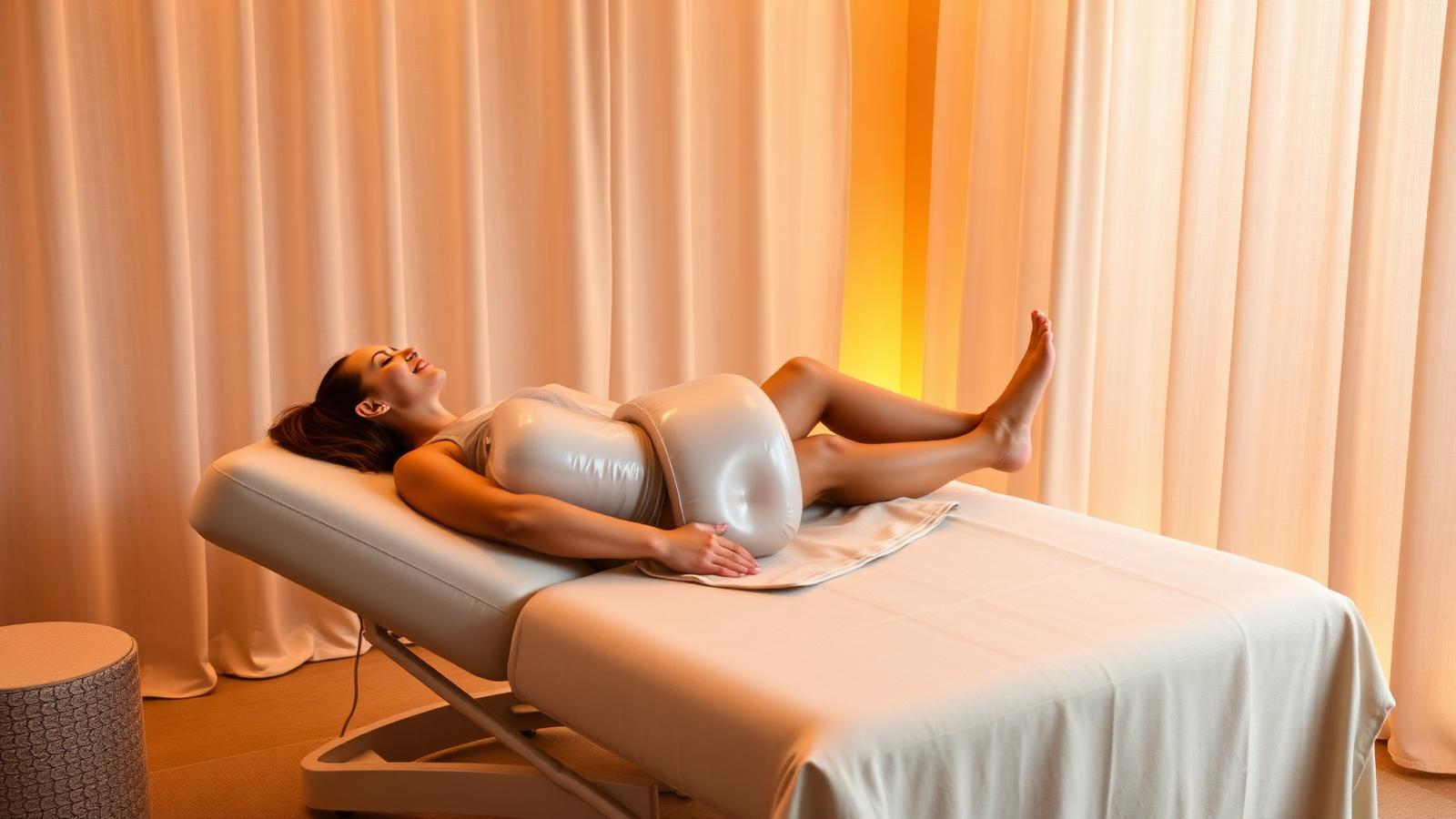
Pressotherapy — sequential pneumatic compression delivered through inflatable garments wrapped around the legs, arms, or torso — entered medicine through the lymphedema clinic, not the spa. Its modern evidence base reflects that origin: strongest where the lymphatic and venous systems are demonstrably impaired, more modest but still measurable in athletic recovery, and largely mechanistic rather than disease-modifying in healthy users.
The lymphedema foundation
The clearest evidence comes from oncology. A 2015 Cochrane review by Stuiver and colleagues evaluated intermittent pneumatic compression (IPC) as an adjunct to complex decongestive therapy in breast-cancer-related lymphedema and found a meaningful additional reduction in limb volume compared with manual lymphatic drainage and bandaging alone.1 A follow-up 2014 meta-analysis in Oncology Research and Treatment pooled trials and reported consistent volume reduction across protocols, with sequential, multi-chamber devices outperforming single-chamber units.2
Venous insufficiency and DVT prevention
In venous disease, the evidence is older and stronger still. The 2014 Cochrane review by Nelson and Hillman on IPC for venous leg ulcers found that compression devices accelerated ulcer healing relative to dressings alone.3 In hospital settings, IPC is a standard, guideline-endorsed intervention for deep-vein-thrombosis prevention in surgical patients who cannot tolerate anticoagulation — the basis for the cuffs many people first encounter after an operation.
Sports recovery: smaller effect, real signal
The athletic literature is more recent and more cautious. A 2021 systematic review in the Journal of Sports Sciences pooled trials of pneumatic compression after endurance and resistance exercise. The pooled effect on perceived muscle soreness at 24 hours was modest but statistically significant, comparable in magnitude to massage and slightly below cold-water immersion.4 A 2016 trial in the Journal of Strength and Conditioning Research by Sands and colleagues found measurable changes in pressure-to-pain threshold and recovery markers after sequential compression in trained athletes.5
The honest summary: pressotherapy accelerates the clearance of metabolic by-products and reduces perceived soreness. It does not, on current evidence, increase peak performance the next day.
What the cuffs are actually doing
Mechanistically, sequential compression mimics the action of the calf-muscle pump. Distal-to-proximal inflation pushes venous blood and interstitial fluid centrally; the deflation phase allows refilling. Doppler studies show roughly 2–3× increases in femoral vein peak velocity during active compression cycles, and lymphoscintigraphy confirms accelerated lymphatic transit in treated limbs.6 A 2013 study in the International Journal of Sports Medicine documented improved post-exercise recovery markers and reduced perceived muscle soreness after a single session.7
| Indication | Strongest evidence | Strength |
|---|---|---|
| Breast-cancer-related lymphedema | Cochrane 2015; meta-analysis 2014 | Strong |
| Venous leg ulcers | Cochrane 2014 | Strong |
| Post-surgical DVT prevention | Guideline-endorsed | Strong |
| Athletic recovery / DOMS | 2021 Sports Sciences review | Moderate |
| Perceived heaviness, daily wellness | Mechanistic + small trials | Moderate |
| Cellulite reduction | Small, industry-funded | Weak |
| "Detox" / fat loss | — | Unsupported |
What the evidence does not yet support
- Cellulite reduction. Trials are small, industry-funded, and inconsistent; the Cochrane infrastructure has not endorsed a treatment effect.
- Fat loss or "detox." No mechanistic basis and no controlled evidence.
- General longevity. No long-horizon cohort data exists, in contrast to sauna and exercise.
The defensible reading is narrow but worth stating clearly: for people with venous insufficiency, lymphedema, or heavy training loads, pressotherapy has decades of clinical evidence behind it. For everyone else, it is a comfortable, low-risk way to accelerate recovery from a hard day on the legs — useful as part of a broader thermal and movement practice, not a standalone intervention.
Sources
- 1.Stuiver MM, ten Tusscher MR, Agasi-Idenburg CS, et al. "Conservative interventions for preventing clinically detectable upper-limb lymphoedema in breast cancer patients." Cochrane Database of Systematic Reviews, Issue 2 (2015). Link
- 2.Shao Y, Qi K, Zhou QH, Zhong DS. "Intermittent pneumatic compression pump for breast cancer-related lymphedema: a meta-analysis." Oncology Research and Treatment, 37(4):170–174 (2014). Link
- 3.Nelson EA, Hillman A, Thomas K. "Intermittent pneumatic compression for treating venous leg ulcers." Cochrane Database of Systematic Reviews, Issue 5 (2014). Link
- 4.Hoffman MR, Mistry D, Glashan CA, et al. "Pneumatic compression as a recovery modality: a systematic review." Journal of Sports Sciences, 39(20):2275–2289 (2021). Link
- 5.Sands WA, McNeal JR, Murray SR, Stone MH. "Dynamic compression enhances pressure-to-pain threshold in elite athletes." Journal of Strength and Conditioning Research, 30(5):1263–1272 (2016). Link
- 6.Chen AH, Frangos SG, Kilaru S, Sumpio BE. "Intermittent pneumatic compression devices — physiological mechanisms of action." European Journal of Vascular and Endovascular Surgery, 21(5):383–392 (2001). Link
- 7.Cochrane DJ, Booker HR, Mundel T, Barnes MJ. "Does intermittent pneumatic leg compression enhance muscle recovery after strenuous eccentric exercise?." International Journal of Sports Medicine, 34(11):969–974 (2013). Link